

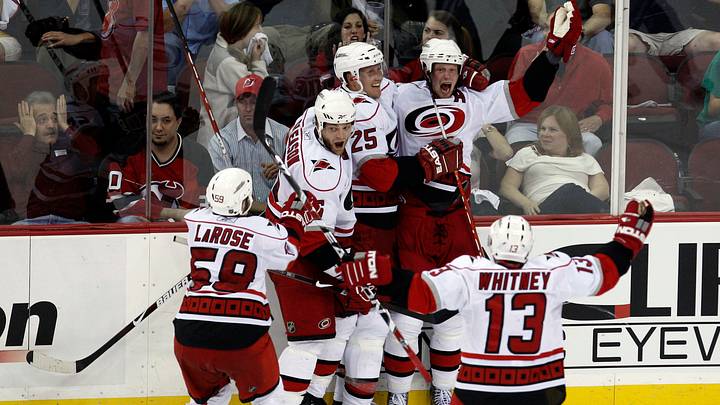
I debated long and hard about which series was the best non-Stanley Cup Final in team history. It came down to the 2006 Eastern Conference Finals and the 2009 Eastern Conference Quarterfinals. Obviously, we have our answer now. As grueling as their series with the Sabres was in 2006, this fight with the Devils featured a few iconic moments, and that's very hard to ignore.
The Canes and the Devils were meeting for the fourth time in as many trips to the postseason for Carolina. New Jersey won the first matchup in 2001, but the Canes responded with their first series win in 2002 and a five-game thumping in 2006. However, unlike in their previous two meetings, the Devils owned home ice, despite missing Martin Brodeur for almost four months.
A torn bicep in early November sidelined the Hall of Fame goalie for much of the year, leaving Scott Clemensen to do the lion's share of the work. To his credit, he was excellent, anchoring the fourth-best defensive unit in the league to an Atlantic Division title. They also had three of the Top 10 Selke finishers on the roster, led by Zach Parise, who also finished in the Top 5 for the Hart Trophy.
#3: A buzzer beater and a shocker help Carolina doom the Devils in seven
When Brodeur returned in late February, he got right back to work, starting 21 of the Devils' final 22 games. There was no doubt whose crease it was heading into the series. On the other side, Cam Ward was in the playoffs for the first time since winning the Conn Smythe in 2006. He'd beaten his childhood idol once already, and he was ready to do it again.
The opening goal of the series was of the self-inflicted kind for the Canes. Ward came out of the net to play the puck off the boards. Instead, it bounced right to Mike Mottau. From well beyond the dots, Mottau's shot snuck under Ward's glove, giving the Devils the lead late in the first. Ward's leakiness got him again early in the second when Parise snuck a shot in from a sharp angle.
The deficit grew midway through the period on Patrik Elias' one-timer from the dot. Ward denied an initial wrap-around chance, but Elias found a soft spot to receive a pass, and he capitalized the second time. Ray Whitney broke the shutout in the third by cleaning up a rebound, but Jamie Langenbrunner's response 29 seconds later finished a 4-1 win for the Devils to begin the series.
The power plays were heard from in Game 2. Parise thought he'd scored midway through the first after he batted a puck past Ward. However, his stick was above the crossbar. Naturally, he scored 26 seconds later with a gorgeous redirection between the dots. Eric Staal evened the score by burying a rebound that popped to him after hitting the end boards. After 20 minutes, we were all square.
Ward and Brodeur locked in the rest of the way. The next 40 minutes came and went without either side breaking the deadlock, sending Game 2 to overtime. Joining the small fraternity of defensemen to score overtime goals in franchise history, Tim Gleason's one-timer from the blue line beat Brodeur just 2:40 into the extra frame, evening the series and snatching home ice from the Devils.
With the Caniacs getting their first look at the series up close, early goals were traded in Game 3. Parise scored his third in as many games on a tip, but Ryan Bayda tied it 31 seconds later after the puck found him below the dots. In the final seconds of the period, Brian Gionta used his silky mitts to work the puck around the Canes' defense and slide it home, giving the Devils the lead after one.
Late in the second, the Canes tied it again. Chad LaRose tipped Patrick Eaves' offering past Brodeur. The rest of regulation passed without a resolution once more, setting up a second straight overtime game. This time, it was the Devils' turn. The first shot was blocked. The second was kicked out. The third was put home by Travis Zajac. The crowd fell silent as the Devils regained the series lead.
The legend of Jussi Jokinen was born in Game 4
Game 4 nearly became a very bad moment in franchise history. Down 2-1 and on home ice, the Canes came out red hot. Staal poked in a rebound to get Carolina off and running. Bayda added his second goal 63 seconds later. Early in the second, LaRose scored another. The Canes were in complete control, up 3-0 with well over half of the game remaining.
Knowing there was plenty of time left, the Devils started chipping away. With 28 seconds left in the middle frame, Gionta scored on a breakaway. Right as a power play ended early in the third, Brendan Shanahan cut the deficit to one. A little over four minutes later, David Clarkson brought them even. The three-goal lead had disappeared, and the prospect of a 3-1 series deficit was troubling.
Time was ticking away in the third period of a tie game, and overtime felt more and more likely. The Canes had the puck in their zone, but they weren't throwing anything at the net. They lacked a sense of urgency, and the fans let them hear it. With one second left, Dennis Seidenberg let his shot go. The horn sounded, and the puck hit the back of the net, but which happened first?
The Canes began to celebrate, while the Devils waited for official word. The shot hit Jussi Jokinen's skate in front of the net, so it would be his goal. The officials confirmed the puck crossed before time expired, and Brodeur lost his mind. There was contact with Jokinen before Seidenberg's shot, but Brodeur clearly initiated well above the crease. With a little theatricality, the series was tied again.
Game 5 was a classic goalie duel. Ward (41 saves) and Brodeur (44) each stood on their heads, but Clarkson's power-play goal in the second period was enough to give the Devils a 1-0 win. Back in Raleigh for Game 6, the Canes fought for their season. Staal scored twice in the second, and Whitney and Jokinen scored in the first and third, respectively, as Ward pitched a 28-save shutout.
The fans at the Prudential Center were properly shocked in Game 7
With their seasons potentially coming down to one game, there was no room for error in the winner-take-all clash at the Prudential Center. The Hurricanes came out of the gates firing, and they struck in 62 seconds. Tuomo Ruutu let a shot go from beyond the right dot, and Brodeur probably should've stopped it. As we'd come to find out, this was a moment of foreshadowing for the Canes.
While the Canes started the scoring, the Devils were quick to answer. Langenbrunner tied it up less than 90 seconds later, bringing the crowd back to life. A little later in the period, Jay Pandolfo won a race to the front of the net, presenting his stick for an easy redirection. After the first period, the Devils owned a 2-1 lead.
Early in the second, the Canes drew even again. Staal, who'd lost the race with Pandolfo, made a gorgeous spin-o-rama pass from below the goal line to Whitney in front of the net. New Jersey's power play put them back in front, with Brian Rolston's shot hitting a defenseman's stick and eluding Ward. By the end of the period, the Canes were in the same boat they'd been in 20 minutes prior.
The Canes pushed to tie it, but the game was stuck at 3-2 as time withered away, along with their hopes. Then, like magic, they found the right combination. Tim Gleason left his skates to keep the puck in the zone and send it to Joni Pitkanen. He brought it down the boards and saw a lane open to Jokinen at the side of the net. He nearly missed, but he didn't. With 80 seconds left, we were tied.
There was still time to do some damage, and the Canes weren't keen on going to overtime in Game 7. Instead, they went for the kill. LaRose left the puck for Staal to carry with speed. From just about the same place where Ruutu scored in the first, Staal snapped his shot past Brodeur with 31.7 seconds left. The Canes had done it. "The Shock at the Rock" was finished as they beat the Devils to advance.
While it wasn't the largest comeback in franchise history, the manner in which the Canes won Game 7 makes it one of their most improbable and highly regarded. They looked like they were done for, especially on the road against a very good team. What makes this series even better is that Game 7 wasn't even the craziest finish. That honor still belongs to Game 4's miracle buzzer beater.
Once again, Cam Ward got the better of Martin Brodeur, which is no small feat. His numbers were slightly better than his icon's, giving him a 2-0 lifetime advantage. Offensively, Eric Staal got hot at the right time. Over the last four games, he scored four of his series-high five goals and picked up six points. He tied Ray Whitney and Chad LaRose for the most points with seven.
The Canes went on to have an equally memorable clash with the Boston Bruins in the conference semifinals, thanks to Scott Walker's Game 7 overtime winner. Then, they began their streak of bad conference final appearances. With this series done, only two remain, and they have something in common. The only question is which Stanley Cup win was better?
 Add us as a preferred source on Google