

At this point, we've talked a lot about the Carolina Hurricanes and the New Jersey Devils in the postseason, and we're here to talk about another chapter today. The Canes and the Devils met to open the 2001 playoffs, and New Jersey laid waste to the Canes, getting out to a 3-0 lead before finally ending their season in six games. In 2002, Carolina had other plans.
The Canes might've won their division in 2002, but the Devils had a better record. However, their 95 points were only good enough for third in the Atlantic Division, putting them as the #6 seed in the East despite being a stronger team overall. It also meant that they would be on the road to begin the series, which felt like a minor flaw in the old formatting.
Offensively, the Devils might not have looked like the scariest team in the world, finishing 20th in goals scored, but they still had players with a ton of success, especially in the postseason. Their real expertise was on the defensive end, led by their captain Scott Stevens and one of the best goalies in the world, Martin Brodeur. Still, the Canes had revenge on their minds.
#8: While the home teams dominated early, one save changed everything
At the Raleigh Entertainment and Sports Arena for Game 1, the Canes gave the home crowd a show early. The game was won in the first period, and the good guys did the scoring. Rod Brind'Amour broke the seal on the power play, getting the series' first goal at the side of the net. Erik Cole, in his postseason debut, got the next one 1:22 later through Brodeur's pads, taking a 2-0 lead.
Despite playing from in front, the Devils were throwing everything they could at Arturs Irbe. Through two periods, the Canes were being outshot 26-9. Still, that surge in the first kept them ahead by two. Patrik Elias got one on the power play in the third, but it was all the Devils mustered. Irbe finished the night with 35 saves, and the Hurricanes held on for a 2-1 win to start the series on the right foot.
Game 2 was a bit of the same, with the Devils controlling the play early. The difference was that Carolina didn't get on the board first. That honor went to Bobby Holik, who scored 37 seconds into the second period to give the Devils their first lead of the series after a bad turnover in the defensive end by the Hurricanes.
The Canes got it back before the end of the period. After a 4-on-4 ended and gave the Canes a power play, beautiful puck movement, especially the pass from Bates Battaglia to Cole, netted them the tying goal. Battaglia's pass nutmegged Stevens, and while Cole didn't get all of it, he got just enough to beat Brodeur and tie the contest.
By the third period, things had swung a little in the Canes' favor, but neither team scored to break the tie, sending the contest to overtime. That's when the home team got the winner. Late in overtime, Marek Malik held the line, floating a shot at the net. Battaglia redirected it past Brodeur, scoring his first postseason goal. For the second game in a row, Irbe outdueled Brodeur, and the Canes won, 2-1.
When the series went up north, everything changed. The new venue rejuvenated the Devils, and they let out some frustration in Game 3. New Jersey's power play was the real star. After Brian Gionta opened the scoring, the Devils' next three goals came while up a man, including two from Brian Rafalski. Brodeur made 16 stops, keeping the Canes off the board in a 4-0 shutout win.
Game 4 wasn't much better. Holik scored in the opening 76 seconds, Gionta scored a short-handed goal, and Rafalski scored his third power-play goal in two games, giving the Devils a 3-0 advantage in the third. Aaron Ward scored late in the game to break Brodeur's shutout, and that's just about the only good thing that happened for the Canes in New Jersey. With a 3-1 win, the Devils had tied it up.
A change in the net was the catalyst for success, led by Kevin Weekes
With the Devils' dominance on home ice, the Canes needed a spark. In both losses, Paul Maurice lifted Irbe for Kevin Weekes. The Canes' backup played well in both relief appearances, so the bench boss gave Weekes the nod for Game 5 in Raleigh. The series was now a best-of-three, and while home ice was still in Carolina's favor, the series was slowly getting away from them.
The Devils got the better chances in the first period of Game 5, and they eventually got the first goal in the second. Holik's fourth of the series gave New Jersey the lead midway through the period. It was quickly answered by Martin Gelinas, whose first of the series tied the game 2:14 later. In a crucial spot, the game was heading to the third period tied at one.
New Jersey got back in front when Elias scored yet another goal on the power play, giving the Devils the lead once more with 8:14 left in regulation. This time, the Canes' power play responded. On a 6-on-4, Jeff O'Neill's persistence at the side of the net paid off. He slammed a loose puck past Brodeur's skate, tying the game and sending the series to overtime for the second time.
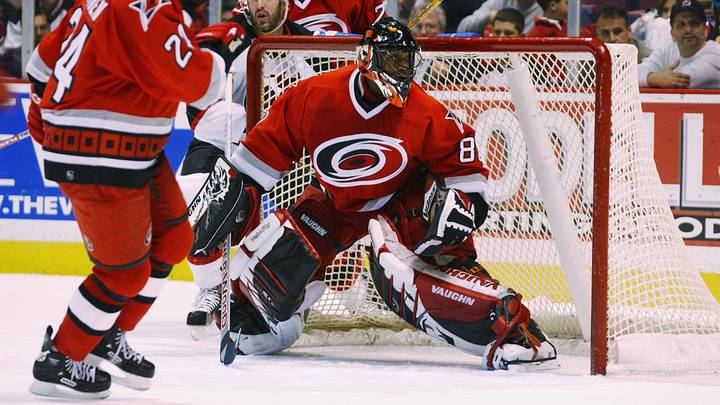
There are big moments throughout the 2002 playoff run. None of them happen without this save. Weekes prevented the Devils from winning Game 5 by making what it affectionaly known as "The Save" in overtime. After stopping Stephane Richer, a rebound lay in front of the net for John Madden. Weekes reached back with his glove and robbed him in broad daylight, keeping the game tied at one.
With their goalie doing everything in his power to keep them alive, the Hurricanes got him the all-important goal to restore their series lead. Jaroslav Svoboda made a sneaky touch pass with two Devils on him to Josef Vasicek, giving him space to shoot. As Brodeur went horizontal, Vasicek lifted the puck past him, giving the Canes a 3-2 advantage with a chance to finish the job in New Jersey.
In a series when special teams had cost the Canes on the road, it's poetic that their power play scored the series-winner. Almost halfway through the game, Ron Francis finally broke through, giving Carolina a 1-0 lead to defend for almost 30 minutes. That's exactly what they did. Weekes stopped all 32 Devils shots, shutting out New Jersey to advance for the first time since moving to North Carolina.
Just like against Montreal, whom the Canes defeated in six games in the next series, this series came down to a decision in the net with the team looking for answers. Arturs Irbe wasn't given much support. Kevin Weekes didn't get much either, but he found a way. In his two starts, Weekes stopped 72 of the 74 shots he faced, though none bigger than the one in overtime in Game 5.
It was a very low-scoring series, with the Devils outscoring the Canes 11-9 despite losing the series. All four of Carolina's wins were one-goal affairs, including a pair of overtime victories. A handful of Devils did most of the scoring, while the Canes relied on their entire lineup. Three players led the way with three points, while Erik Cole was the only Hurricane with multiple goals.
While it might've been the first series win since relocation, it was also the franchise's first since the Whalers swept the Nordiques in 1986. That was a best-of-five series, meaning they'd never won a best-of-seven. It also ushered in an era of postseason dominance over the Devils, which continues to this day. However, the best clash with New Jersey is yet to come.
 Add us as a preferred source on Google