

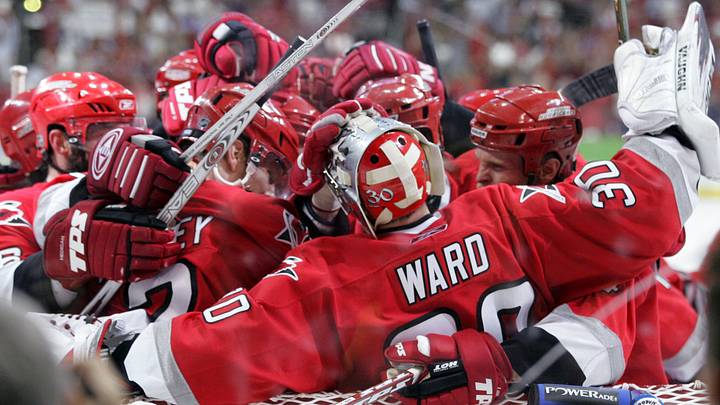
The Carolina Hurricanes rolled into the 2006 Eastern Conference Finals. After dropping their first two games to the Montreal Canadiens, they'd won the next four to finish the series in six games before pounding the New Jersey Devils in five. To this point, minus that early speed bump, the Canes were feeling pretty good heading into the third round for the second time since 2002.
The team standing between them and the Stanley Cup Final was the Buffalo Sabres. Finishing second in the Northeast Division with 110 points, the Sabres forged a similar path as the Canes through two rounds. They started by scoring a lot of goals in a six-game triumph over the Flyers. Then, they made quick work of the East's top team, the Ottawa Senators, in five games.
The Canes and the Sabres represented two of the five best offenses in the league during the regular season, and while Carolina wasn't nearly as good defensively, they'd gotten pretty stingy during this run. They also had rookie netminders leading the way. Cam Ward had won eight of his last nine games, and Ryan Miller, while a little streakier, had proven tough to beat when he was on.
#4: The Canes emerge from a seven-game war thanks to Game 7 heroics
I'm not sure if this qualifies as a "fun" fact or not, but the Carolina Hurricanes have never won Game 1 in the Eastern Conference Finals. Historically, they are 0-7 in Game 1, five of which came on home ice. Of course, that means 2006 is among them. The Sabres came to town to begin the series and put the Hurricanes and their fans on notice.
Henrik Tallinder opened the scoring early, but Rod Brind'Amour drew the Canes even midway through the frame. In the second, Daniel Briere, who'd grow into a massive thorn in Carolina's side in this series, pushed Buffalo ahead in the second, and Jay McKee's goal in the third was the insurance they needed. The Canes got a late one, though the Sabres held on for a 3-2 win.
In Game 2, it was Carolina's turn. Both power plays were lethal to start the contest. Frantisek Kaberle got the ball rolling by clapping one home. Thomas Vanek responded with a weird redirection in front of the net to tie the game in the final minute of the period. The Canes' second power-play goal early in the second, courtesy of Ray Whitney, restored the lead.
Whitney doubled down later in the middle frame, wiring a one-timer from between the dots past Miller to extend the Canes' lead. Justin Williams added to it in the third, and it's a very good thing that he did. Buffalo scored twice in the third, one of which came in the dying seconds, but the Canes had done enough to earn a 4-3 win to even the series.
Game 3 in Buffalo was the second bit of adversity that the Canes had to face. This time, their rookie netminder was at the forefront. Cory Stillman scored to break the ice, but Chris Drury's redirection on the power play kickstarted a massive Sabres push. Briere scored twice in the second, including one on the power play, and Ales Kotalik made it 4-1 a little more than halfway through the game.
After coming off the bench in Game 2 against Montreal, the shoe was on the other foot. Peter Laviolette made the change in the net, bringing Martin Gerber back into the fold. The Canes fought to draw even, with Stillman scoring his second of the game and Eric Staal scoring late on the power play. It wouldn't be enough to prevent the Sabres from taking a 2-1 series lead.
It was Gerber's crease for Game 4, and he wasn't ready to give it up just yet. The team around him responded accordingly, jumping out to an early lead in the first. Mark Recchi started the scoring just under seven minutes in. Three minutes later, Staal snapped one from the right dot on the power play to double the Canes' advantage.
The Sabres didn't have a response for the Canes in Game 4. Andrew Ladd scored his first playoff goal early in the second, and Bret Hedican got his first of the playoffs in the third. Honestly, they could've stopped scoring after the first one. Gerber, making just his third appearance in over a month, posted a 22-save shutout. The Canes knotted the series once more with a 4-0 victory in Buffalo.
Stacking back-to-back wins was the difference for Carolina
At this juncture in the series, no one had won back-to-back games. Heading home with some momentum after their shutout win, the Canes had a chance to change that. Gerber was back in the crease for Game 5, but the Sabres came prepared. They held a 2-1 advantage after the first period, and Toni Lydman's goal 1:55 into the second prompted another goalie change.
Rested after his short stint on the bench, Ward was back in the saddle. Once again, the Canes responded. Recchi's second in as many games came less than four minutes after the change, cutting Buffalo's lead to one. On a power play midway through the frame, the captain tied it. Brind'Amour unleashed a one-timer from the dot to knot it at three.
After combining for six goals in 30 minutes, the rest of regulation featured none, sending this powder keg of a series to overtime for the first time. On the power play, the Canes snatched the series lead. Stillman was on the spot again, burying a rebound in front of the net to win the game, giving the Canes two chances to reach the Stanley Cup Final.
Ward made 15 stops in relief to earn the win in Game 5. Naturally, he was in the crease for Game 6, needing just one win to end it. With their backs against the wall, the Sabres scored first. JP Dumont potted a second chance at the top of the crease, getting the home crowd going early in the opening period. That lead stood until Hedican tied it with 3:53 left in regulation, sending Game 6 to overtime.
The Canes' celebration had to wait a bit longer. Doug Weight took a boarding penalty early in overtime. The penalty kill was six seconds away from finishing the job. Unfortunately, they couldn't do it. Briere let a shot go from the left dot. Ward got his glove on it, but he didn't get it all. The puck popped up and banked in off Ward's back, ensuring the Eastern Conference Finals went the distance.
Since relocating in 1997, the Hurricanes had never played a Game 7. While individual players had, this team hadn't. With their season on the line for the first time in the playoffs, the Canes had to dig deeper than ever before. Mike Commodore scored first. His shot was going wide of the net, but it got a friendly bounce off a Sabres defender, giving the Canes a 1-0 lead after 20.
Buffalo's offense was quiet until the final five minutes of the second. Doug Janik tied it with 4:10 left, and Jochen Hecht banked a shot off Ward from below the goal line with under five seconds left, giving the Sabres a 2-1 lead at the second break. Weight came out in the third and atoned for his Game 6 blunder, tying it early to set up a tense conclusion. That's when the captain struck again.
As he had all postseason, Brind'Amour found the perfect time to pounce. With the Canes on the power play, he located the loose puck in front of the net first to roof it against Miller, giving the Canes the lead with time dwindling. The Sabres couldn't get Miller to the bench before Williams finished it for good. With a 4-2 win, the Canes were back in the Stanley Cup Final.
Sabres fans will be quick to point out how they'd lost several key defensemen heading into Game 7. I believe that the 2006 Hurricanes were a team of destiny. When they won Game 5, the Prince of Wales Trophy was theirs to lose. Eight Hurricanes had multiple goals in the series. Cory Stillman wrote his name into the history books as well, becoming the second Hurricane with ten points in a series.
As much as this battle was won on the ice, there was a battle going on behind the benches too. Peter Laviolette's handling of the goalies in this series was masterful. When his team was on the ropes in Game 3, he turned to Martin Gerber. When things looked bleak in Game 5, he went back to Cam Ward. He knew the right time to pull the trigger on a switch, and it led to the Canes getting it done.
During their almost 30 years in North Carolina, there might not be a series as physically demanding and hard-nosed as this one. It was a war in every sense of the word. The Canes and the Sabres put on a show for seven fantastic games. Ultimately, Carolina finished the job, setting themselves up for a shot at redemption in the 2006 Stanley Cup Final.
 Add us as a preferred source on Google