

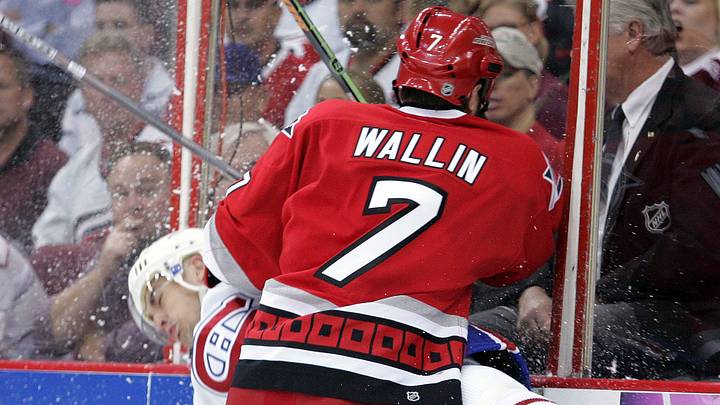
If you asked anyone on April 25, 2006, what the odds of the Carolina Hurricanes winning the Stanley Cup less than two months later would be, I'd bet they were pretty low. Alas, they proved to be just fine. No Stanley Cup run is perfect, and few are without their hiccups. For the 2006 Hurricanes, their biggest hurdle to get over was their rough start against Montreal.
Carolina was back in the playoffs for the first time since their run to the Stanley Cup Final in 2002, and they were better than ever. They'd won the Southeast Division. They'd set franchise records in several categories. They'd done better than many expected. Now, the Canes were among the favorites to win the Eastern Conference.
Across from them stood the Montreal Canadiens. Stuck behind a pair of wagons in their division, the Habs snuck into the field as the #7 seed, finishing third to Ottawa and Buffalo. They were far from dominant, sitting in the middle of the league in many respects, but those are the types of teams you worry about pulling off a big upset, and Montreal came very close.
#11:
Kicking off the series at the RBC Center, Game 1 started well for the Hurricanes. Matt Cullen scored 50 seconds into the contest, giving the fans an early reason to get excited. The longer the game went, the less celebrating the home crowd did. By the end of the first period, Montreal had already taken a 2-1 lead on the Canes.
The deficit only grew from there. Montreal added a pair of goals in the second and third periods to further run up the score. Cristobal Huet stood on his head, too, stopping 42 of Carolina's 43 shots. With their 6-1 win to begin the series, the Canadiens made a statement to the Hurricanes and the rest of the league. They weren't going to be an easy out.
They continued to make that statement in Game 2. The Canadiens scored three times in the opening 14:46, chasing Martin Gerber from the game with a 3-0 lead. Gerber had been good during the regular season, winning a franchise-record 38 games. In less than four postseason periods, he was on the bench, having allowed nine goals.
In his place, rookie Cam Ward took the crease. The team responded to the change, scoring the next four goals. Cullen picked up his second of the series before three straight power-play goals, two by Rod Brind'Amour and one by Ray Whitney. However, Montreal scored twice in 36 seconds to regain the lead early in the third.
With a 2-0 series hole drawing near, Cory Stillman scored the tying goal with 1:30 left in regulation, sending Game 2 to overtime. It turns out, the Canes were delaying the inevitable. After no one scored in the first overtime, Michael Ryder's second goal of the game came 2:32 into double overtime. The Canes had gone from easy favorites to on the verge of disaster.
A changing of the guard and an OT winner provided the Canes a spark
This 2-0 deficit was a genuine shock. The Hurricanes owned the Canadiens during the regular season, outscoring them 25-9 in a four-game regular season sweep. Now, they were two losses away from their season ending. For all intents and purposes, their hopes were in the hands of a rookie netminder making his first postseason start in one of the most hostile environments in the league.
The moment didn't seem to be too bright for Ward, who looked excellent in Game 3. The only blemish on his night was a power-play goal by Richard Zedmik midway through the second period. Meanwhile, Huet continued to look unbeatable. After back-to-back 40+-save performances in Raleigh, the Canes struggled to find ways to beat him.
Alas, a hero emerged in the third period. The captain snuck a shot between Huet's pads with 8:33 left, breaking the shutout. Just like that, the Canes might've found their spark. In overtime once again, the Canes made it a series. On the power play, Eric Staal wired a one-timer past Huet from the point, giving the Canes some newfound life. Suddenly, the comeback was on.
I don't think we talk about how close the rest of this series was. Game 4 saw the Canes get off to a quick start, leading 2-0 after goals 71 seconds apart by Justin Williams and Aaron Ward. Montreal responded with two in the second period, but the captain was there to be the hero again. Brind'Amour scored early in the third. The series was tied at two games each, making it a best-of-three.
Back in Raleigh for Game 5, the Canes' power play did its job. Staal scored early in the first, and Cullen doubled the lead late in the second. Alex Kovalev scored in the final minute of the middle frame, but that's all Montreal got against Ward. The rookie made 30 stops to back his power play's big game, putting the Canes one win away from advancing.
Game 6 in Montreal turned into a war between two desperate teams with warring mindsets. Carolina wanted to advance. Montreal wanted to survive. Sheldon Souray and Mark Recchi traded goals 30 seconds apart in the first period, and that's all of the scoring we'd get for 60 minutes. For the third time in the series, overtime was needed.
The ending was a little anti-climactic, but it went in the Canes' favor. Stillman clapped a shot from just inside the blue line past Huet 1:19 into overtime, bringing the opening round to its conclusion. It's probably one that Huet should've stopped. Still, it brought the culmination of an excellent series victory for the Canes after hope was in short supply following Game 2.
Not to be dramatic, but Cam Ward probably saved the Hurricanes' season. Emerging in Game 2 to relieve Martin Gerber, Ward finished with a .940 save percentage and a 1.54 GAA in five appearances, outdueling Cristobal Huet, who was excellent in his own right (.929 SV%, 2.33 GAA). It was a beautiful start to what became a franchise-altering career for the Hurricanes Hall of Famer.
Eric Staal and Rod Brind'Amour played a big part in the comeback, too. Their goals in Game 3 turned the tide of the series. Staal led the team in points (8), including a franchise-record four assists in Game 2. Brind'Amour paced the Canes with four goals while averaging more time on ice than anyone else in the series (26:11). That's what leadership is all about.
We'd have to wait 20 years for these teams to meet in the postseason again, coming this past May in the Eastern Conference Finals. Once again, the Hurricanes had Montreal's number. There's one more series between these two that needs to be discussed, and we'll do so tomorrow. We've seen some miracles before, but one of the first might've come in 2002, when these two met for the first time.
 Add us as a preferred source on Google