

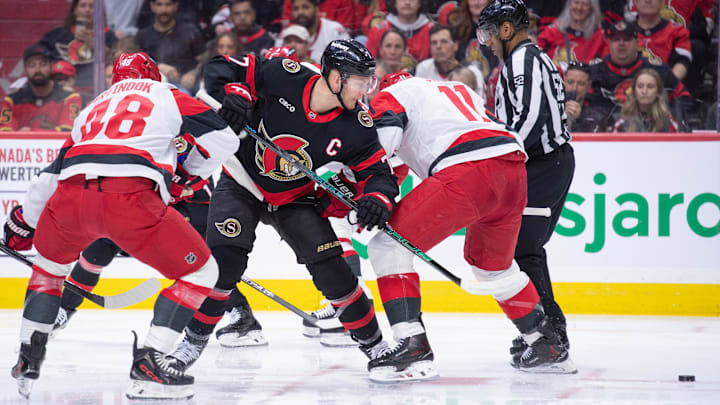
You know the headline by now, but I'll say it again to drive the point home. The Carolina Hurricanes swept their way through the first round, beating the Ottawa Senators in four games to win a series for the eighth straight season. It wasn't as easy as the result shows, but it counts all the same. Ahead of the series, we laid out some keys to victory for the Canes.
For a refresher on what those five keys were, you can find them here. None of these keys were particularly ground-breaking, and many were points that those smarter than me had also raised ahead of the series. In hindsight, the Canes actually crushed these keys. For one final breakdown of the series, let's look at just how well they mastered these keys.
1. The Hurricanes embraced Ottawa's physicality
Right from the opening draw in Game 1, we knew the Hurricanes weren't going to shy away from the Senators. As one of the most physical teams in the league this season, Ottawa was going to lay the body as much as they could. Jordan Staal agreed to fight Brady Tkachuk to start the series, and it only got tougher from there.
The Canes outhit the Senators in Game 1, and while Ottawa bested them in that regard over the next three games, the disparity wasn't that wide. Ottawa ended the series with a 173-163 edge, though William Carrier led all skaters with 26 hits. Dylan Cozens (22) and Andrei Svechnikov (21) were the only others with more than 20. The Canes didn't shy away, and that's what matters.
2. Both goalies stepped up, but Andersen outdueled Ullmark
Goaltending was destined to be a story of the series one way or another. There was reason to believe this would be about how it would negatively impact each team, but it turned out to be the opposite. Frederik Andersen and Linus Ullmark were the best players on their respective teams. Ullmark made some truly insane saves in the series. Unfortunately, he wasn't given much support.
Andersen set the tone by shutting out Ottawa in the first game. From there, he only allowed five goals, only one of which was truly bad. There appeared to be a chance that Brandon Bussi would get the start in Game 4, but Andersen was playing too well to sit with a chance to close it out. He was my first star of the round for the Canes, silencing plenty of critics along the way.
3. There was nothing hot about either power play
My third key focused on not allowing the Senators' power play to get hot. After watching this series, I don't think anyone is going to accuse either power play of being remotely good. Through four games, only the Buffalo Sabres, who are 0-for-17, have a worse power play than the Senators. Ottawa went 1-for-21 in the series. It took them until Game 4 to finally get on the board.
However, for as bad as Ottawa was while up a man, the Hurricanes weren't much better. They went 2-for-18, which is fifth-worst in the league to this point. Logan Stankoven scored both goals, though they each came at big points in the series. If there's one area that must be better for the Canes moving forward, it's their power play.
4. One area the Canes still struggled in was face-offs
Another sore spot for the Hurricanes was their performance in the dot, though we knew that was likely to be the case against one of the league's best face-off teams. The Senators showed exactly why throughout the series, winning over 58 percent of the draws. Everyone who took at least one face-off for Ottawa finished better than 50 percent.
The Canes are usually good in the dot, but the Senators outclassed them more often than not. Even Jordan Staal, who won a series-high 49 face-offs, only won 46 percent of the time. Mark Jankowski was the team's best center in that regard at 47.4 percent. If there's one glimmer of hope, it's that both potential opponents in the next round were below 50 percent during the regular season.
5. Carolina's depth, in general, proved too tough for the Senators
It was mentioned earlier, but it bears repeating here as well. The Ottawa Senators only scored five goals. However, breaking it down further shows even bigger problems. Drake Batherson had three goals, and Dylan Cozens had two. That's it. During the series, only seven players scored a point for Ottawa, including only one for Tim Stutzle, and none for Tkachuk, Claude Giroux, or Shane Pinto.
The Hurricanes had one line carrying most of the load, with Logan Stankoven (4-1-5), Taylor Hall (2-5-7), and Jackson Blake (1-3-4) combining for seven goals and 16 points. However, the Canes received greater contributions overall, even from those whose statlines were a little more barren. They didn't blow Ottawa away. They simply outworked them. That's what it takes to sweep an opponent.
 Add us as a preferred source on Google