

We've reached the Top 10 series in Carolina Hurricanes history, which also means we're heading into the home stretch. The Hurricanes' run in 2002 might've ended on a sour note, but their journey through the Eastern Conference was quite the spectacle. You might've noticed that we hadn't talked about the first three series during that run. Well, that is remedied today.
The Canes were through the conference quarterfinals for the first time since relocation. They'd won the Southeast Division while finishing with the fewest points of any division champion in the league. They weren't the most remarkable team in the world, but they fought hard. It's a big reason why they'd beaten the Devils to begin the postseason.
The Canadiens were the final team into the field in a very tight Eastern Conference. They won one more game than the Canes during the regular season, yet they sat four points back of them. It didn't stop them from upsetting the top-seeded Bruins in six games. It certainly helped that they had Vezina and Hart winner Jose Theodore on their side.
#10: While tight to start, one comeback flipped the script for Carolina
The series began with a bang, and not one that the Hurricanes were too keen on. Less than five minutes into Game 1, Jeff O'Neill was assessed a major penalty and a game misconduct for checking Sheldon Souray from behind. Just like that, they were down their leading goal scorer from the regular season. Fortunately, the Canes killed it without allowing a goal.
Theodore and Kevin Weekes were walls in Game 1. For two periods, neither flinched. Ron Francis finally drew first blood early in the final frame to give the Canes the all-important first goal. Erik Cole added to the lead late in the third, celebrating in Doug Gilmour's face after stealing the puck from him. Weekes posted another shutout as the Canes got off to a good start.
With O'Neill suspended for Game 2 as well, the Canes needed to show that same fight. Instead, Montreal showed that this would be a series. Saku Koivu snapped Weekes' shutout streak with a goal in the first, and Andrei Markov added another late in the period. The sides traded power-play goals in the second period, and Montreal added an empty-netter to even the series with a 4-1 win.
As the series went north of the border for the next two games, the Hurricanes got O'Neill back, but their fortunes didn't change much. The Canes fought to tie Game 3 at one in the third period on a Bates Battaglia goal, but Donald Audette scored early in overtime to give the Canadiens a 2-1 series lead. Theodore continued his brilliance, stopping 33 shots. Montreal was now in control.
The Molson Miracle changed the Hurricanes' series and season
The Hurricanes needed a better start in Game 4. They didn't get it. Montreal scored less than a minute apart midway through the first period, taking a 2-0 lead into the break. When the teams came out for the second period, Arturs Irbe led the Canes onto the ice, making his first appearance since Game 4 against New Jersey. Montreal got another in the second, opening up a 3-0 lead after 40.
Gifted a 5-on-3 at the beginning of the third, the Canes began their comeback. Sean Hill blasted a one-timer past Theodore, finally bringing the offense to life. Battaglia got a second with just over seven minutes left, clapping another home to cut the deficit to one. With Irbe on the bench, the Canes tied it. Erik Cole cleaned up a mess in the crease with under a minute left, tying it up at three.
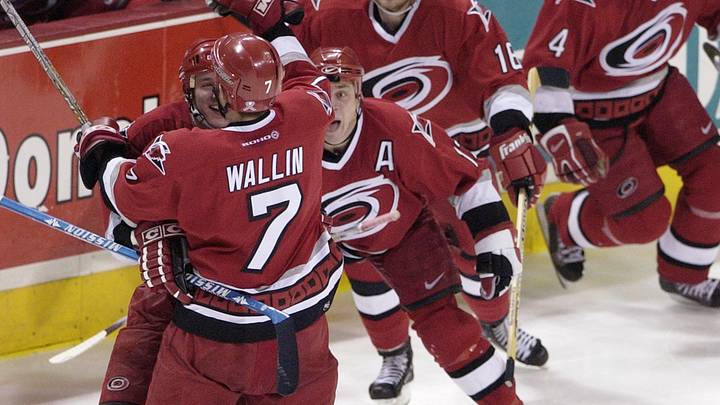
All of the momentum was on the Canes' side as they went to overtime for the second game in a row. The Canes were one shot away from either being pushed to the brink or tying the series. Fortunately, it was the latter. In what is now affectionately known as the Molson Miracle, Niclas Wallin's shot from the point surprised Theodore, capping the improbable comeback with his first playoff goal.
This win flipped the switch for the Hurricanes because they didn't give the Canadiens a chance in Games 5 and 6. Back at home with the series tied, the Canes imposed their will. They got goals early in the first and second periods from Martin Gelinas and Rod Brind'Amour, but they really pulled away in the third period.
Francis scored another early-period goal on the power play to make it 3-0. Tommy Westlund scored his first, and only, postseason goal to quadruple the lead. Even when Montreal felt one semblance of excitement, Battaglia was there to score his third goal in as many games to complete the team's rout of the Habs in Game 5, 5-1.
Game 6 was even uglier. The Canes scored five times in the first period, chasing Theodore from the game and putting the writing on the wall that the series was finished. Cole scored twice in the opening 3:33. Hill buried another on the power play. Josef Vasicek and Kevyn Adams added to the fun. Montreal scored in the final seconds, but the Canes led 5-1 at the break.
In the second period, they kept on going. Battaglia and Hill scored on the power play, and O'Neill got the eighth with under eight seconds left, giving the Canes the second-most goals in a playoff game in franchise history. Montreal scored the only goal in the third period, though it wasn't nearly enough to create concern. With an 8-2 win, the Canes were marching on to the Eastern Conference Finals.
The trio of Bates Battaglia, Rod Brind'Amour, and Erik Cole, affectionately known as the BBC line, was all over the scoresheet. Battaglia became the first player in franchise history to record ten points in a series, getting at least one in all six games. Cole tied Battaglia for the most goals with four while tying Brind'Amour for the second-most points with seven. No Canadiens skater had more than four points.
The Molson Miracle remains one of the greatest comebacks in franchise history, and a big catalyst in this win was the decision to switch goalies. Kevin Weekes hadn't played poorly, with his sub-.900 save percentage underselling just how good he'd been. However, Arturs Irbe was outstanding once he took over, posting a .947 save percentage and a 1.48 GAA in three victories.
While they're meeting four years later might've been closer all-around, and this year's conference finals clash has recency bias playing in its favor, I think this is the best of the three Montreal series, largely because of its ending. Game 4 is an all-timer, and the follow-up in Games 5 and 6 was epic to relive. It's a good way to kick off the Top 10.
 Add us as a preferred source on Google