

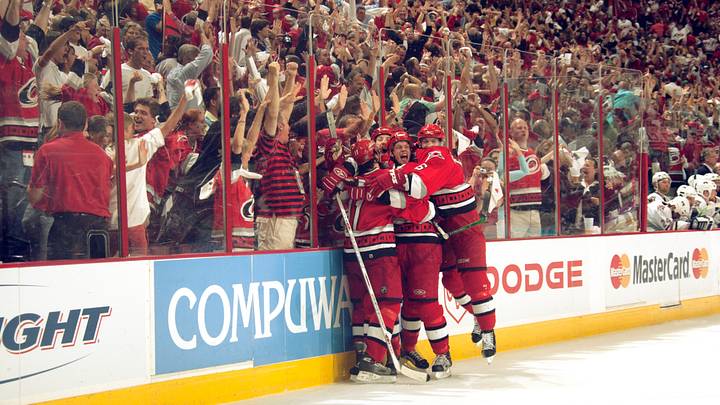
The Carolina Hurricanes' path to the 2006 Stanley Cup Final was a long and winding road. It featured a few goalie changes, some magical moments, and a seven-game war with the Buffalo Sabres, but they'd gotten back to the Cup Final for the second time. With the memories of the 2002 loss still fresh in some players' minds, the Canes knew what they needed to do to finish the job this time.
The Edmonton Oilers didn't care much for odds and presumed favorites. After entering the postseason as the #8 seed in the West, the Oilers had beaten their share of Goliaths. Their run started by beating the Presidents' Trophy-winning Red Wings in six games. They dropped the first two against San Jose before winning four straight. Then, they beat Anaheim in five.
By no means a team of stars, the Oilers were playing better than they had all season. Chris Pronger was putting up big numbers, tied for the team lead in scoring with Shawn Horcoff heading into the series. The real story was Fernando Pisani, who was tied for the league lead in goals through three rounds (9). The Oilers showed no fear, and the Canes were ready for it.
#2: The Hurricanes reach the top of the mountain for the first time
Of course, it didn't look like they were quite ready for it from the outset of Game 1 at the RBC Center. While Mike Commodore laid a massive hit on Ryan Smyth early, it was Pisani and the Oilers getting on the board first. Cam Ward stopped the first chance, but Pisani grabbed the rebound and buried it into the open net to start the scoring.
In the second, Niclas Wallin was cited for covering the puck in the crease, giving the Oilers a penalty shot. Pronger was their man for the job, and he beat Ward to his blocker side to double the lead. Then, Ethan Moreau got a friendly bounce off Aaron Ward late in the period, pushing the Canes' deficit to three. It wasn't looking pretty for the home team.
Fortunately, the Canes never felt out of a game. With 2:43 left in the second, Rod Brind'Amour finally got his team on the board. Then, Ray Whitney came out in the third and went on a tear. He cut the deficit to one with a transition one-timer and tied it on the power play less than four minutes later. Justin Williams scored a short-handed goal halfway through the third to give the Canes the lead.
With the lead for the first time, the Canes had shifted everything in their favor. Of course, their netminder did his part, too. He robbed Horcoff blind with his arm, keeping his team in front. Unfortunately, Ales Hemsky scored a beautiful goal on the power play to tie it at four with 6:29 to play in regulation.
Then, the moment that changed the series. Late in the third, Andrew Ladd was forced into Dwayne Roloson by an Oilers defender. The collision took Roloson out of the series, with Ty Conklin taking the net. His legacy will be the turnover behind the net that allowed Brind'Amour to steal the puck and score with 31.1 seconds left. Add one more insane save on Horcoff, and Game 1 was Carolina's.
With Roloson out, the Oilers inserted Jussi Markkanen into the series for Game 2. He'd started 32 games for Edmonton during the regular season, but he hadn't played since early March. The Canes gave him a rude welcome. A good defensive play at the blue line allowed Frantisek Kaberle to spring a 2-on-1. Andrew Ladd finished the sequence, giving the Canes the first goal of the contest.
It was just the beginning for them. Carolina's power play was especially good. Kaberle scored on the man advantage midway through the second. Cory Stillman added another with less than three seconds left at even strength. In the third, Doug Weight and Mark Recchi each added power-play goals, completing the 5-0 rout to take a 2-0 series lead.
Game 3 in Edmonton allowed the Oilers to draw some life from their fans. Horcoff finally got one past Ward with a redirection early in the first. Markkanen shut the Canes down for most of the game, but Brind'Amour got one midway through the third to tie it. Ultimately, the Oilers earned their first win after Smyth legally used his body to put a rebound home. The Oilers were in the fight.
Life wasn't any easier in Game 4 for Carolina. Sergei Samsonov put the Oilers in front with a nice tip, but Stillman immediately responded 29 seconds later on the power play. Recchi broke the tie late in the second, so it was on Ward to finish the job. It was a low-event game for both sides. Ward saw just 21 shots, but he stopped 20 of them, sending the Canes home with three chances to end it.
They needed all three chances, but the Stanley Cup belonged in Raleigh
With Lord Stanley in the building for Game 5, the anticipation was through the roof at the RBC Center. Pisani scored 16 seconds into the game to bring the excitement down a little. It was just the beginning of a wild first period. The Canes' power play continued to do its thing, scoring the next two. Eric Staal potted a rebound, and Whitney clapped one from above the dots to give Carolina the lead.
Edmonton regained its composure and snatched the lead back before the break. Hemsky added a power-play goal for the Oilers, and Michael Peca scored in the final minute to snatch momentum back. In the second, the Canes got the only goal, and it was their power play again. Staal earned his second of the night by poking it home from behind the net.
After a flurry of offense to begin the night, both goalies settled in. Regulation ended without another goal, sending the series to overtime for the first time. The Canes drew an early penalty, giving them a chance to finish it on the power play. Instead, the Oilers stayed alive. Stillman's weak pass attempt was intercepted by Pisani, and he scored a short-handed breakaway to prolong the series.
An overtime loss wasn't the only thing the Canes were dealt in Game 5. Nine seconds into the third period, Weight was sandwiched by two Oilers. The hits injured his shoulder, knocking him out for the game and the series. However, all wasn't lost. Erik Cole, just over three months after suffering a broken neck, was healthy enough to play in Game 6 in his place.
Unfortunately, the Canes played about as uninspired a game as they could've, given the circumstances. The Oilers ran the show for 60 minutes. Edmonton scored three times on the power play over the final 40 minutes, and Markkanen stopped all 16 of Carolina's shots to earn a 4-0 shutout win. The 2006 Stanley Cup Final needed a winner-take-all Game 7 in Raleigh.
After watching their team get smacked in the mouth repeatedly in Edmonton, the Caniacs took it upon themselves to set the tone for Game 7. Over the next few hours, the fans spent the entirety of regulation on their feet, doing everything they could to cheer their team to victory. Having witnessed it firsthand, it was an environment unlike any other.
The Hurricanes responded in kind by immediately grabbing the lead. Recchi was trying to find Ladd in front of the net, but Markkanen got his paddle on it. Instead, the puck slid to Ward at the blue line, and he hammered it through traffic to get the Canes on the board 86 seconds into Game 7. It's all the scoring we'd get in the first period.
In the second period, the lead was doubled, and it was the power play again. Cole drew a holding penalty. Kaberle extended the lead eight seconds later. His shot hit Jason Smith's hip and redirected under Markkanen's pads, giving the Canes a 2-0 lead. Their lead held after two, but the Oilers weren't going quietly. Pisani's fifth goal of the series came 1:03 into the third, setting up a tense conclusion.
The 2-1 lead stuck for most of the period, with Ward doing all he could to keep his team ahead. With 3:40 left in the game, Ward made one more incredible stop. Raffi Torres threw the puck at Ward. Pisani drove the net and was first to the puck after Ward kicked the first chance out. Ward stuck out his left pad and robbed Pisani of the tying goal, holding onto the puck for the whistle.
The Oilers never found that tying goal. With Markkanen on the bench late, the Canes sealed the deal. Williams got free with the puck and a vacant net, putting the series away for good. The players on the ice started going nuts. The players on the bench did, too. After the final 61 seconds trickled away, the Carolina Hurricanes were Stanley Cup champions for the first time.
In the immortal words of Doc Emrick, the Hurricanes had been absolutely relentless during their run to the Stanley Cup. Whether it was the heroics of their captain Rod Brind'Amour, who led the team with 12 goals in the playoffs, or their rookie netminder Cam Ward, who won the Conn Smythe Trophy as the postseason MVP, this was a team of destiny. They wouldn't be denied their spot in history.
Seven Hurricanes had multiple goals in the Stanley Cup Final, led by Brind'Amour and Ray Whitney with three each. None of them topped Fernando Pisani's five. Eric Staal was the leading point scorer in the Final with eight, though none more iconic than his assist to Justin Williams on the empty-net clincher. They won this series as they'd done everything this season. They did it as a team.
Up until right when I sat down to write this, the 2006 Final was my pick as the best series in franchise history. After all, Game 1 was incredible, and the series went the distance, with the Canes coming out on top. However, when taking into account the series as a whole, I don't think it has as strong a case as 2026. You never forget your first championship, and I know that especially rings true for the fans.
 Add us as a preferred source on Google