

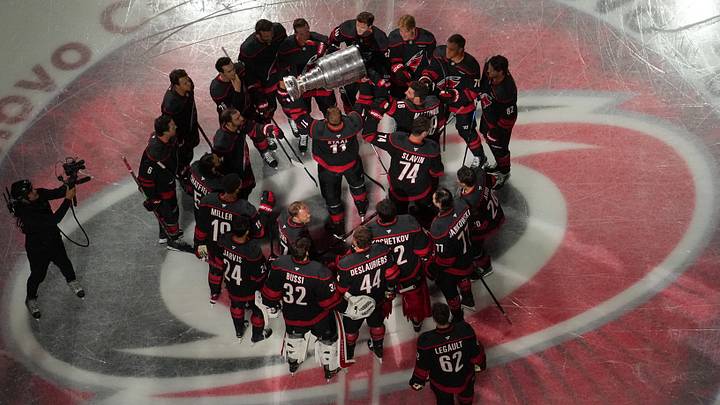
We've made it through the first week of the season, and the Carolina Hurricanes have a lot of work to do. They brought back almost their entire Stanley Cup roster, yet the early results have been mixed. Their offense was nowhere to be found on Opening Night, their defense disappeared on Friday, and they dominated much of Saturday before finally winning in overtime.
For the first bit of the season, you'll likely hear the term "Cup Hangover" when talking about the Canes, especially from the national media. The Stanley Cup is the hardest trophy to win for a reason, and even if three teams have repeated as champions in the last decade, it's much easier said than done. The journey to get back to the top will be tough, and history tells us exactly that.
The "hangover" can be seen in a few different forms, but one of the most challenging aspects stems from the shortened offseason that comes with it. Teams that don't make the playoffs see their season end in early to mid-April, while the eliminated playoff teams follow every few weeks. For the teams in the Stanley Cup Final, the turnaround is a little different.
This summer, the Hurricanes and the Vegas Golden Knights finished their series on June 14, less than two weeks before the NHL draft and just 17 days before free agency began on July 1. The reason we don't talk about this with Vegas is that they were on the wrong side of it. The Canes partied non-stop and had a parade to celebrate the moment, making the hangover a little more literal.
All this talk about Cup Hangovers got me thinking about how other teams fared after winning the Stanley Cup, especially at the beginning of the following season. I looked at every champion during the Salary Cap era, determined how many days were between the final game of the Cup Final and the first game of the next season, how they started, and how they finished. The results varied.
There's one easy comparable for this team that hits closer to home
You might recall that the first Stanley Cup champions of the Salary Cap era were the group from Raleigh, beating the Edmonton Oilers in seven games to claim the organization's first championship. However, the honeymoon was short for the Hurricanes. The 2006-07 season was anything but smooth for the defending champs, and it began with a rocky start.
There was a little more roster turnover for the 2006-07 team, with several key pieces exiting. Matt Cullen, Frantisek Kaberle, Mark Recchi, Cory Stillman, and Aaron Ward were gone from the Game 7 roster, with Eric Belanger, Tim Gleason, Trevor Letowski, David Tanabe, and Scott Walker replacing them on Opening Night.
The Canes lost their first four games, dropping their Opening Night clash with Buffalo in a shootout before three straight multi-goal regulation losses to the Devils, Capitals, and Panthers. Through ten games, they sat at 4-4-2, and while the Canes' record would improve from there, they struggled to string enough wins together to separate themselves from the pack.
Instead, they sat in the middle of the Southeast Division and the Eastern Conference. On March 24, they were tied with Montreal for the final spot in the East. A three-game losing streak pretty much ended their season. They fell four points behind, went 2-2-0 in April to finish the season, and missed the playoffs, becoming the third defending champion to not qualify for the following postseason.
There isn't an exact science that explains why the Hurricanes missed the playoffs that season. Part of it could be the 30-point decrease from Eric Staal. It could've also been Cam Ward getting used to being a starting goalie for the first time at 22 years old. They had 107 days between games, the same number of days as this year's team. Maybe there's something to this after all.
The 2006-07 Canes were an outlier compared to other champions
Since the 2004 lockout, two more teams have joined the Canes in failing to make the postseason after winning the Cup. The 2014-15 Kings fell two points shy after winning their second title in three seasons, and the 2025-26 Panthers dealt with injuries all season. Otherwise, 17 of the last 20 champions have qualified for the playoffs, which is probably what the Caniacs want to hear.
When factoring in a few shortened seasons over the last 20 years, defending champs average roughly 47 wins and 102 points in their next season. Many of them come out of the gate hot, too. The 2009-10 Penguins started 9-1-0. The 2023-24 Golden Knights topped them at 9-0-1. Even those who struggled to start usually turned it around after ten games.
Postseason hockey is a different beast, and things get a little murkier. There, it's usually feast or famine. We've seen the Penguins, Lightning, and Panthers repeat as champions. The Lightning made a third straight trip in 2022 but fell short, and the 2009 Red Wings failed to defend their crown in a rematch against the Penguins.
Isolated success is expected, but the majority of winners seldom return to that level immediately after winning. The average champion is bounced early the next year. Eight champions have lost in the first round of their subsequent defense, and two more failed to make it past the second round. I guess that's why they call it the toughest trophy to win in sports.
One argument used factors in the number of days between the final playoff game and the first game of the next season. I don't find that to matter much. The 2025 Panthers repeated after an offseason of 106 days, the fewest days for any champion during a proper 82-game season in this era. Tampa Bay repeated after a 97-day offseason, though their wins came during shortened seasons.
Real or not, and there is plenty to suggest both, it's all in the hands of this year's Carolina Hurricanes. There is nothing that we can do while watching from the stands, from our couches, or wherever you enjoy Hurricanes hockey. It's all up to the team on the ice. It's still a little too early to know how much the Canes are dealing with the hangover, but it can't be an excuse when they play poorly.
 Add us as a preferred source on Google