

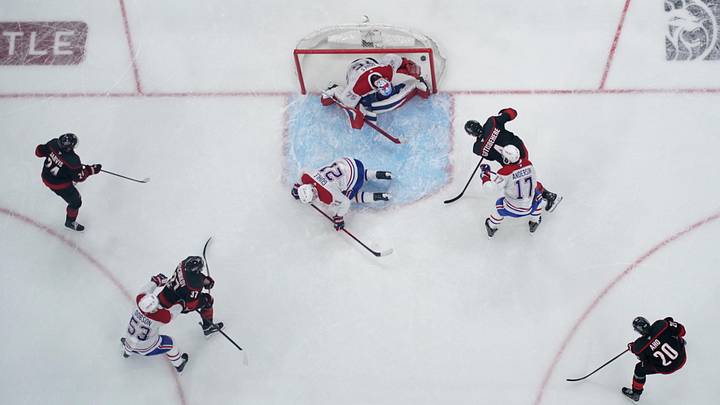
In the first round, we laid out our keys against the Senators, and the team knocked them out of the park. In the second round, we did the same against the Flyers, and those results were a little more mixed. Against the Canadiens, we did it one more time, and the Canes got it done once again. Of course, we don't take credit for that. That honor goes to the team on the ice.
1. Montreal's power play hardly got to work
One of the most concerning areas for the Hurricanes coming into the series was whether or not they could stay out of the box. They'd been on the penalty kill more per game than any other team in the league. Against one of the most lethal power plays in the league, they needed to be disciplined to prevent them from taking over the series.
That's exactly what they were. The Hurricanes only had to kill 13 penalties during the series, owning a 19-13 edge in power plays in five games. Better yet, the teams were an even 2-2 in power-play goals. The only one of consequence that Montreal scored was the tying goal in Game 3. Otherwise, they didn't do a thing, and that's part of why the series finished as quickly as it did.
2. The Canes owned a decided edge up the middle
In Game 1, everyone on the Habs' roster played well. That was especially true for their centers. Nick Suzuki had three assists. Phillip Danault had a goal and an assist. Jake Evans found the scoresheet as well with a helper. Danault continued with a multi-assist performance in Game 2. However, that's where their production ended. Of their nine points in the series, only one came after Game 2.
Meanwhile, the Canes' group stayed productive throughout the series. Logan Stankoven led the way with four points, three of which came in Game 5. Sebastian Aho had three points, as did Mark Jankowski, including the primary helper on the Game 2 overtime winner. Jordan Staal might've finished with one point, but he had a series-high 32 hits and won 56.7 percent of his draws.
3. Rust was an early issue, but Montreal's lack of rest was their undoing
There is no doubt in my mind that the time off between Game 4 against the Flyers and the start of the conference finals played a big part in how the Hurricanes played in Game 1. That amount of time off led to consistent breakdowns in the neutral and defensive zones as the Canadiens handed them their first loss of the postseason. However, that wouldn't be the norm.
It became clearer as the series went along that the Canadiens were running out of steam. They were hardly getting any shots on goal. Their offense had fewer goals over the next four games than it had in the opener. Their stars were non-factors. As the Canes got their legs back under them, they took over the series, finishing the job with a pair of lopsided victories.
4. Dobes was the only reason the Habs stayed in the series
Before the series, I was concerned about whether the Canes could solve what I dubbed their "Jakub Dobes problem." He'd been very good against them in both March meetings. Game 1 didn't provide much hope. As the series went along, I started to gain more faith until they finally exploded on offense in Games 4 and 5. I'd say the team found a solution.
That being said, a few bounces were the difference between the Canes leading or trailing the series after Game 3. Dobes was easily Montreal's best player in the series. The Canes threw the kitchen sink at Dobes every game, and he responded by keeping his team in close games. He'd have more to show for it if they'd done him some favors offensively.
5. The past is in the past as the Canes write a new chapter to their story
I, like many, was concerned when the Canes lost Game 1 in as demoralizing a fashion as they did. I didn't think the series was over by a long shot, though the doubts started to creep in, especially after how badly they were beaten last season. However, when they came back in Game 2 and got in the win column, it was clear that this team was different, and they showed it in this series.
This felt like seven years of frustration being taken out on the Canadiens. It culminated in two very one-sided contests to close the series, leaving no doubt that the Canes were the better and more deserving team. Now, they're playing for the Stanley Cup for the first time in 20 years. Their job isn't done, but this was a moment that felt a long time in the making.
 Add us as a preferred source on Google