

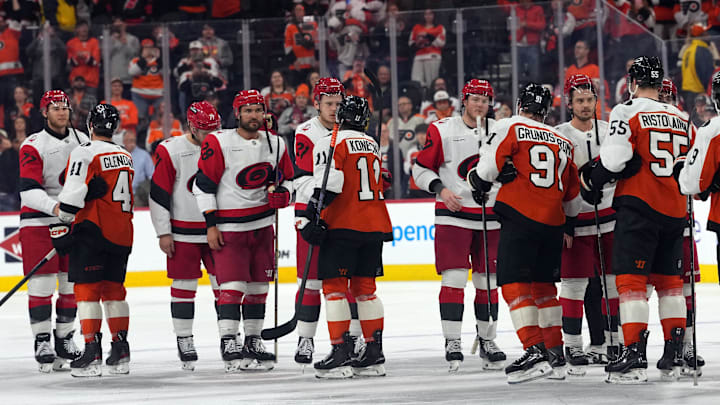
Coming into their series with the Philadelphia Flyers, there were legitimate concerns surrounding how much rest would be too much for the Carolina Hurricanes. It turns out, their week off wasn't much of an issue. They picked up where they left off in the first round and did the same thing to the Flyers in the second round, finishing them in four games.
Much like their opening set with the Ottawa Senators, this wasn't a straightforward sweep. It was very tight. However, when comparing the two series, this felt less strenuous than the first one. Still, across the board, the advantage belonged to the more experienced team. Let's take a look back at the Hurricanes' second-round sweep of the Flyers.
Stories of the Series
Defense continues to rule the day: During the regular season, the Hurricanes were the second-highest scoring team in the league, behind only Colorado. Their defense was tied for fifth in goals against, but their offense was the driver for most of the year. That hasn't been the case through two rounds. Three goals per game is good, but just over a goal per game against is better.
The Canes have only allowed ten goals in eight games, allowing no more than two in any game thus far. This series is littered with big defensive moments. K'Andre Miller's dive to prevent a Garnet Hathaway breakaway in Game 1. Jaccob Slavin's goal-line stick prevented a goal in Game 3. They're doing everything they can to suppress their opponents. It has been working pretty well thus far.
Another stellar round for the PK: Another reason for this continued defensive success has been their work on the penalty kill. The Hurricanes have spent more time short-handed per game than any other team in the league. They also have the best penalty kill at 95 percent. They have allowed two goals on the power play, while scoring one short-handed.
In this series, the Canes' penalty kill went 18-for-19, with their lone blemish being the opening goal of Game 2. After that goal against, the Canes killed their next 14 attempts to finish the series. They had a pair of 3-on-5 kills and allowed just two shots. The Flyers' power play was the worst in the league during the regular season, yet the Canes made it look even worse.
Injuries derailed the Flyers a bit: I've never felt that injuries alone can be the sole reason that a team loses a game or a series, but it's hard to ignore that the Flyers were without their top goal scorer for the duration of the series. Owen Tippett didn't play at all after the Pittsburgh series, taking a major force out of their Top 6.
To further that point, Noah Cates suffered a lower-body injury after Game 2, and it was enough for the Flyers to immediately rule him out for the remainder of the series. Playing without two playmakers forced some shuffling for Game 3, and their absences only compounded their struggles for sustained offense. It led to their inevitable demise.
A first-of-its-kind feat: By winning eight games in a row, the Canes accomplished quite a few impressive feats. For starters, they're the fifth team to win their first eight postseason games. Three of the previous four won the Stanley Cup, so that's hopefully a good sign. It also establishes the longest postseason winning streak in franchise history, surpassing their seven-game streak in 2006.
However, the four other 8-0 teams didn't do it the same way that the Hurricanes did. The Hurricanes are the first to sweep two best-of-seven series to begin a postseason. Before 1987, the division semifinals were a best-of-five, and those four teams did it before the format change. It adds another level of history to an already incredible start.
Best Game: The Canes face their first deficit, comeback in Game 2
After starting the series the same way they began the postseason, with a shutout in Game 1, the Canes had yet to face any adversity. The Flyers, needing a better start after a poor showing in the opener, immediately jumped on the Canes in Game 2. Jamie Drysdale scored on the power play to hand the Canes their first deficit, and Sean Couturier added another goal 31 seconds later.
The home team was forced to dig deep. Nikolaj Ehlers slapped a one-timer on the power play to cut the deficit in half before the first intermission. Then, Seth Jarvis tied the game in the third with his first goal of the postseason. All of this led to another overtime encounter, which Taylor Hall ended. Jackson Blake kept a rebound alive, sliding it to Hall for the winner and a 2-0 series lead.
Best Moment: Blake phinishes the job in overtime
I've stated before that I prefer for the Canes to finish their opponents convincingly in regulation, though I sometimes appreciate their flair for the dramatic. That has been a common theme in series-clinching games throughout their history. This won't be remembered in the same way as Scott Walker's or Brock McGinn's Game 7 overtime winners, but they all count the same.
It's only appropriate that the Stankoven line did the honors in overtime. Jackson Blake scored the Canes' first goal in the second period and added the winner in overtime. Dan Vladar was magnificent in Game 4, but you'd think he might want both of Blake's goals back. This shot grazed his glove and popped up before crossing the line. The "Heartbreaker" celebration at center ice was a nice touch.
Three Stars of the Series
Third Star: After being named the second star of the Ottawa series, Taylor Hall took a "slight step back" against the Flyers. Of course, this means he finished with just five points in four games. His five points were second on the team, and his 12 for the postseason have him sitting in fourth in the NHL, as of Sunday, though that will change with the players around him still playing.
Hall picked up points in both games at home, none bigger than his overtime-winning goal in Game 2 to cap the comeback. After being kept off the scoresheet in Game 3, Hall responded with assists on all three Carolina goals in Game 4, including the primary helper on the series-clincher. His four assists were tied with one of his linemates for the most on the team.
Second Star: I could easily copy-and-paste what I wrote about Frederik Andersen after the Ottawa series, because his numbers are strikingly similar after this series as well. His .945 save percentage and 1.14 GAA are only slightly worse than his .955/1.10 line from the first round. Still, he only allowed five goals and won four games, so that's about all that matters.
Andersen broke his tie with Cam Ward for the most postseason wins in franchise history by winning his 24th in Game 1. That win happened to be a shutout, the fourth of his postseason career with the Canes, which ties him with Ward for the most. He's yet to allow more than two goals in a game, making him the fourth goalie to do so in his first eight games, and the first in almost 60 years to do so.
First Star: Of the dangerous Stankoven line trio, Jackson Blake was the only player who didn't crack my Three Stars of the Series against Ottawa. This time around, he's at the very top. Blake finished alone or tied for first in goals (3, tied with Logan Stankoven), assists (4, tied with Hall), and points (7). He finished the series with three points in Game 4, including the series-clinching goal in overtime.
His three-point performance was his third multi-point effort of the series, going with two-point efforts in Games 1 and 2. With his winner in Game 4, Blake became the youngest Hurricane to score a series-clinching goal, beating out Sebastian Aho by over a year. He's the second youngest in franchise history, behind only Ulf Samuelsson.
 Add us as a preferred source on Google