

For the first time since 2014, NHL players are back at the Winter Olympics. After two cycles without the best in the world competing, best-on-best hockey returns to the global stage, with the 4 Nations last February being a good teaser for what is to come. Frankly, it's hard to believe that the NHL has only been involved at the Winter Games five times, first appearing in Nagano, Japan, in 1998.
Whenever the NHL has gone, a few Carolina Hurricanes have gone, too. This year, there will be five Hurricanes playing in Milan. Sebastian Aho (Finland), Nikolaj Ehlers (Denmark), and Frederik Andersen (Denmark) were among the initial announcements this summer. Jaccob Slavin (United States) was named after New Year's, and Seth Jarvis (Canada) got the call just days before departure.
At least two players have represented the Hurricanes at each of the five games with NHL involvement since 1998. As we prepare for the start of the men's tournament later this morning, I wanted to take a look at what those players have done during their time at the Winter Olympics. Some did more than others, but the experience itself is more valuable than anything.
I'd be remiss if I didn't talk about the Olympian on the roster currently. In 2022, Alexander Nikishin represented Russia under a neutral committee, due to the ongoing political climate that has prevented them from competing since. He didn't record a point in six games, but the Russian Olympic Committee took home the silver medal, giving him Olympic hardware before signing with the Canes.
1998: Kapanen and the (Future) Captain
When the NHL sent its players to participate in the Olympics for the first time, two Hurricanes were in their midst. Keith Primeau earned a spot with the Canadian team, while Sami Kapanen represented Finland in Nagano. Primeau was a little more productive than his teammate, but Kapanen came home with a little hardware.
Playing on a team with the likes of Wayne Gretzky, Steve Yzerman, Joe Sakic, Martin Brodeur, Patrick Roy, and the man he'd later be traded for, Rod Brind'Amour, Primeau held his own. He did all of his damage in the group stage, setting up Theo Fleury short-handed in Canada's opener and scoring twice against the Americans. However, the Canadians were kept off the podium by Kapanen's Finns.
Finland didn't have a good group stage, losing two of its three games. Kapanen's only point of the tournament, an assist, came in Finland's lone group win, an 8-2 drumming of Kazakhstan. However, the Finns pulled off a big win over rival Sweden in the quarterfinals and bounced back from a loss to Russia to beat the Canadians in the Bronze Medal Game, securing the first medal in Canes history.
2002: Kap is back, and the goalies came, too
When the Olympics returned to American soil in 2002, Sami Kapanen returned with them, becoming Carolina's first two-time Olympian. He was joined by the Canes' goalie tandem of Arturs Irbe (Latvia) and Tom Barrasso (United States), giving the team one more Olympian than they had during the previous cycle.
Despite being the Canes' primary goalie during the 2001-02 season, Irbe took a backseat to Sergejs Naumovs, who'd helped the Latvians qualify for the Olympics. Irbe only appeared once in four games, allowing four goals to Germany in their group-deciding game to prevent Latvia from advancing to the next group stage.
The second time around was more productive for Kapanen, but Finland failed to get back on the podium. Kapanen scored his first Olympic goal in a rout of Belarus, and he added two assists in a win over Russia. In the quarterfinals, Finland couldn't muster much offense against the Canadians, losing 2-1 to bring their bid for a medal to an end.
The only Hurricane to medal in 2002 was Barrasso, who, like Irbe, played second fiddle in the rotation. Barrasso backed up Mike Richter for the Americans on home turf. His only action was their 8-1 win over Belarus. He allowed a goal 20 seconds in, but he stopped everything else over the next 59:40. The United States fell to Canada in the Gold Medal Game, sending Barrasso home with the silver.
2006: A massive Carolina contingent
The largest group of Hurricanes to appear in the same Olympics was during the 2006 Winter Games in Turin. Five players and Head Coach Peter Laviolette made the journey to Italy, and that doesn't include forwards Matt Cullen and Eric Staal, who were reserve players for the United States and Canada, respectively.
Most of these Canes suited up for the Americans, with Laviolette in charge on the bench. Erik Cole, Bret Hedican, and the newly acquired Doug Weight took the ice for their bench boss. It was not a good tournament for the U.S, finishing 4th in their group. Cole and Weight finished with three points each, while Hedican registered an assist as the group was eliminated in the quarterfinals by Finland.
It was an up-and-down tournament for Switzerland's Martin Gerber. He was pulled in their first game against Finland, but he followed it up with a 49-save shutout against Canada. Gerber was on the wrong side of the team's quarterfinals loss to Sweden, conceding six goals in the loss, finishing the Olympics with a 1-2-0 record and a 4.14 GAA.
The lone medalist of the group was Frantisek Kaberle, who took home the bronze with the Czech Republic. Kaberle only recorded one point in eight games, providing the primary helper on a goal in the team's quarterfinal win over Slovakia. The Czechs lost to the eventual gold medalists, Sweden, in the semifinals, settling for bronze after shutting out Russia to conclude their 2006 Games.
2010: The Year of the Medalists
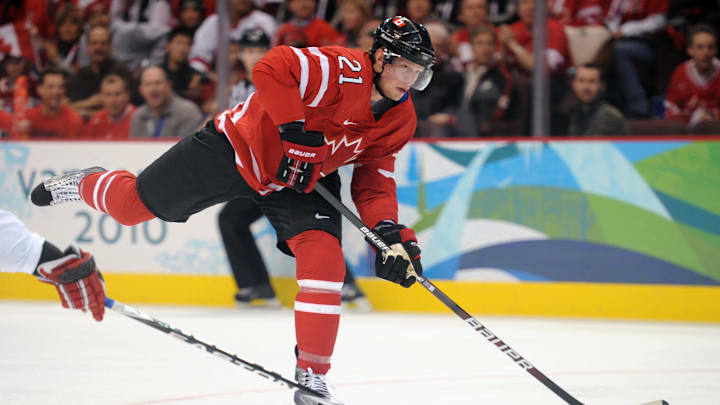
The Hurricanes sent four players to the Olympics in Vancouver, and all four came home with medals of various colors. Eric Staal helped Canada bring home the gold in front of the home crowd, beating Tim Gleason and the Americans in the final game, while Joni Pitkanen and Tuomo Ruutu secured the bronze for Finland.
It wasn't a very exciting tournament for either of the Finns. All three of Pitkanen's points came on the power play, including a goal against Germany in the group stage. He also added an assist during the Bronze Medal Game against Slovakia. Ruutu's only point came during that same Germany game as Finland finished third in the tournament.
Gleason wasn't initially named to the Americans' 2010 roster, but he earned the call as an injury replacement shortly before the Olympics began. He didn't record a point during the Games, though he played in all six of the U.S.'s contests. Gleason was on the ice for almost 15 minutes in the Gold Medal Game against the Canadians.
Staal was the most productive Hurricane in Vancouver. The Canes' star finished with six points in seven games. His only goal came during Canada's group stage loss to the U.S. before providing three helpers in the playoff-opening win over Germany. By winning the gold at the Olympics, Staal joined the Triple Gold Club to go with his World Championship gold and his Stanley Cup.
2014: Ruutu returns and repeats in Russia
Four years after claiming bronze, Tuomo Ruutu returned to represent the Finns, bringing with him Andrej Sekera (Slovakia), Justin Faulk (USA), and Alexander Semin (Russia). Faulk's journey was pretty easy to document. The 21-year-old only played in two of the Americans' games during the tournament, failing to find the scoresheet as the U.S. lost in the Bronze Medal Game.
It was not a fun tournament for Sekera and the Slovakian team. After a lopsided loss to the U.S. to open the tournament, they couldn't best Slovenia or Russia, finishing last in the group stage. They fell behind to the Czech Republic and never recovered, ending in a 5-3 exit. Sekera provided both of his points during the loss to the Czechs.
The Russians had a far more interesting time. Semin recorded an assist on Russia's first goal of the tournament, setting up former teammate Alex Ovechkin. That was the only time he found the scoresheet in Sochi. Russia had that very entertaining shootout game against the U.S. and made it to the quarterfinals before losing to Finland.
Ruutu joined an exclusive club during his second trip, becoming the second Hurricane to represent the team at multiple Olympics, along with fellow Finn, Sami Kapanen. He was much more productive the second time around, finishing just outside of the Top 10 in scoring with a goal and four assists. Ruutu and Finland claimed the bronze, making him the first Cane with multiple Olympic medals.
 Add us as a preferred source on Google