

Superstitions exist in every sport, but in fewer places is that more apparent than in the NHL. Whether it's through a player's pre-game routines or team activities like sewer ball, superstitions can be found just about everywhere. That sentiment is extended to how teams interact with the league's top trophies. There's a "curse" attached to just about everything. It comes off as a little silly.
Still, many take stock of whether certain traditions are followed, and that's especially true of how conference champions treat their respective conference trophies. While the Stanley Cup is the ultimate prize, the top team in each conference plays for a secondary trophy, the Prince of Wales Trophy in the East and the Clarence S. Campbell Bowl in the West.
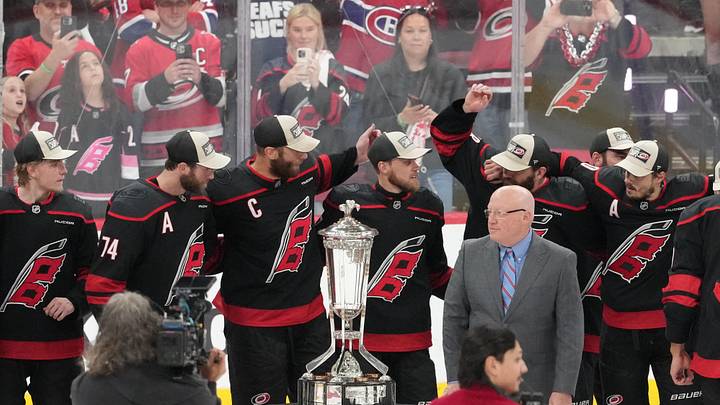
As you've probably noticed by now, the Carolina Hurricanes and the Vegas Golden Knights emerged to represent their respective conferences in the Stanley Cup Final beginning on Tuesday night. Many watched with bated breath as each team surrounded Deputy Commissioner Bill Daly after finishing their series and took a picture with their newest hardware to see whether or not they'd touch it.
Believe it or not, some people believe that touching these trophies can determine whether or not that team will win the Stanley Cup. Of course, what really matters is what happens on the ice, but I can't knock people for clinging onto whatever they need to. Still, it's fun to look deeper into this, so that's exactly what we're going to do.
This year's team didn't touch it, and team history says that's a good thing
Rod Brind'Amour knows a thing or two about winning the Prince of Wales Trophy with the Carolina Hurricanes. He was on the teams that won the conference in 2002 and 2006. Naturally, that means the players on this year's team went to him for advice. In his postgame interview, the head coach cracked a joke, saying that he didn't care whether the team touched it, so long as they didn't touch it.
Hysterical.
— Walt Ruff (@WaltRuff) May 30, 2026
Rod Brind'Amour said he didn't really have any input on the team not touching the trophy.
Then, he told on himself. 😅
"I had a couple of guys ask me what I thought, and I said, 'You do what you want.. but don't touch it.'" https://t.co/CyKpysIbd9 pic.twitter.com/jxC9cPR6Ar
Historically, this is the right move. In 2002, Ron Francis touched the trophy, and while the Hurricanes won Game 1 in overtime on a Francis goal, they lost the series in five games to the Detroit Red Wings. Four years later, with Brind'Amour as the captain, the team didn't touch it, and they won the Stanley Cup in seven games. That, in itself, should be enough evidence. However, there's more to the story.
In both cases, the Canes' opponent in the Stanley Cup Final did the same thing that they did. Detroit touched the Clarence S. Campbell Bowl in 2002, and Edmonton didn't touch it in 2006. Vegas has followed a similar path. They touched it in 2018 and lost, but they didn't touch it in 2023 and won. Their opponents, Washington and Florida, did the same things as them during their respective runs.
There are some interesting trends since the turn of the century
I must admit that I didn't compile this data on my own, so here's a link to the Twitter post that breaks down what each team has done since 2000. When going year over year, there are some things that immediately stand out, especially since a few teams played in the Stanley Cup Final several times in a short span.
The first thing is the long gap when Western Conference teams refused to touch the Bowl from 2006 to 2017. For some teams, that strategy worked. The Blackhawks did touch it during any of their three Cup runs, nor did the Kings during their two. However, only the Ducks in 2007 benefited from never touching it. Detroit didn't touch it in 2008 or 2009, but they only won it the first time around.
In the East, teams seemed to reverse course when it didn't work out the first time. Pittsburgh didn't touch the Trophy in 2008, and they lost. When they touched it in 2009, they won and continued to touch it in 2016 and 2017. The Panthers did the same thing in reverse. The Cats touched it in 2023 after beating the Canes, but they lost to Vegas. They did the opposite in 2024 and won back-to-back.
The truth is that is doesn't really matter, but you already knew that
For every example of touching or not touching the trophy working out for a team, there are several cases to contradict it. The New Jersey Devils are a great one. They represented the East three times from 2000 to 2003. They touched the Prince of Wales Trophy all three times and won two out of three. They didn't touch it in 2012 and lost to the Kings.
The Tampa Bay Lightning are another good example. They've represented the East five times since 2000. They didn't touch the Trophy in 2004 and won the Stanley Cup. In 2015, they kept their hands off it and lost. They changed it up in 2020 and won. They did the same in 2021 and repeated as champs. However, the third time wasn't the charm in 2022 after touching it and losing to Colorado.
Look, I know that you didn't need me to tell you that it doesn't matter, but this was actually fun to look at, especially since we make such a big deal about it in the aftermath of the conference finals. The Hurricanes and the Golden Knights will have to settle this on the ice. There's no magical force in the universe that decides the outcome based on how each team celebrates, and that's perfectly fine.
 Add us as a preferred source on Google