

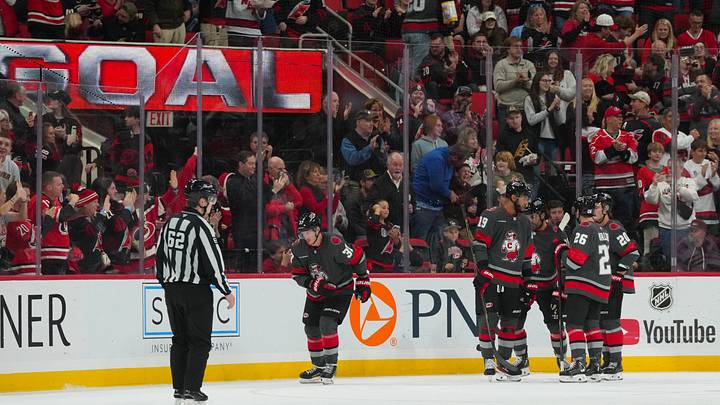
The Carolina Hurricanes had a pretty good weekend. They beat the Oilers and the Rangers on back-to-back days, recovering from a disappointing result on Thursday against Montreal. In both wins, the turning point was obvious. It was the second period. The Canes dominated the middle frame on both days, and that's hardly new for them this season.
Through 24 games, the Canes own a 46-20 advantage in the second period. Their +26 goal differential is the largest in the NHL for any team in any period. They're a league-best +45 overall, with Minnesota the next closest at +37, but there's a significant gap between second and third. Carolina and Minnesota are operating on a different plane than everyone else in many respects.
Because I'm a numbers guy, I wanted to see how impactful the second period has truly been for the team. With a goal differential that wide, how many times has the second period influenced the final result? Trends in sports are very important to follow. Sometimes, in cases such as this, they explain why the Hurricanes have gotten off to an exceptional start.
The Canes' dominance in the second period has directly led to victories
Obviously, the goal is to play with the lead in the NHL, and the Canes have done a very good job in that respect, scoring first in 16 of their 24 games. When you're 18-3-3, situational records always seem to skew positively, regardless of whether you score first or not. The Canes are 14-1-1 when they score first, yet they're still 4-2-2 when they don't.
Just because they score first doesn't mean they're holding that lead at the end of the period. They've been tied after 20 minutes 11 times, compared to eight times when they've held the lead going into the first break. Again, they have just one regulation loss in those tie games (7-1-3), coming in Calgary. They've yet to lose when leading after 20 (8-0-0).
However, we're talking about the second period. The Canes have outscored their opponents in the middle frame 14 times, including ten instances where they outscored them by multiple goals. They've only been outscored three times, and two of those came in the first three games against Washington and Philadelphia. If you'll recall, they were already down bad to the Capitals and won in Philly.
More often than not, the Canes used a massive second period to fortify a lead they already had, though I counted five times when their work actively won them the game, and there honestly might be more. These include both aforementioned wins last weekend, Montreal at the beginning of the season, their second trip to Philadelphia, and St. Louis to close the State Fair trip.
Five games might not seem like a lot, but imagine if the Canes had lost those games. They'd have 29 points and would barely be in second place in the division. Even if they managed to squeak out a few wins, they wouldn't have the comfortable cushion atop the Metro they've earned thus far. The Canes have been locked in as a team all season, but the second period has been their biggest ally.
Several Hurricanes have feasted during the middle frame
When breaking it down individually, you can see why Carolina's success has been so evident. Eight players on the roster have at least eight points in the second period. Nikolaj Ehlers and William Carrier have eight assists each. Sean Walker might only have 13 points, but nine of them have come in the middle frame, and he's not the only defenseman thriving. Shayne Gostisbehere has 11 points.
For Jackson Blake and Andrei Svechnikov, the second period isn't even their best. They each have ten points in the second, with Svechnikov scoring seven goals. Blake has done a little more damage in the first, where he has 11 of his 23 points. Svechnikov's best work has come in the third period, where he also has 11 points. Logan Stankoven is second on the team with 14 points in the second.
It should come as no surprise that Sebastian Aho leads the team in both second-period goals (8) and points (17). After all, he leads the team with 33 points and is tied with Svechnikov with 13 goals. For context, the league's three leading scorers, Connor McDavid, Kirill Kaprizov, and Leon Draisaitl, aren't that far ahead of him in second-period scoring. Draisaitl leads the pack with 20 points.
The second period is often looked at as the toughest strategic period because of the long change, with the benches further from the defensive zone. The Canes appear to be taking advantage of that to perfection. They're making life miserable for their opponents all night every night, but this is on a different level. It's even crazier when you consider they were even (80-80) in the period last season.
 Add us as a preferred source on Google